– Siddartha Nemali, Research Lead
“The teacher, the child’s window to learning and knowledge, has to play the role model in generating creativity in the child”.
In this quote from Ignited Minds, Dr. APJ Abdul Kalam emphasizes the role of a teacher in generating creativity, learning, and knowledge in children. What a teacher does and says can have a powerful and pervasive effect on students’ classroom behaviour and engagement (Stefanou, Candice R., et al 97). However, across the world, one of the common difficulties educators face in a classroom is keeping students engaged. Scholars like Mohammad Zohrabi, Kunni Han, Ira Shor, and others have referred to Henri Holec’s famous concept called Learners Autonomy as a solution to this problem. This blog discusses the adoption of Learners’ Autonomy in Indian schools to achieve student ownership, engagement, and creativity.

AI Generated image from Magic Media, CanvaWhat is Learners’ Autonomy?
In simple terms, enabling a Learner’s Autonomy in a classroom means letting students decide how they want to learn a concept (Little 1). In education, it is well-known that different students have different needs, capabilities, and interests. To achieve maximum student engagement and learning outcomes from diverse student groups, teachers have to provide a stage where students can display their creativity. One possible way is by letting students decide how they want to learn a concept – Learner’s Autonomy.
Given the syllabus constraints and lack of space and time for innovations (Aggarwal 218), this concept may appear inflexible in an Indian setting. However, it is quite possible and enriches the experience for both teachers and students.
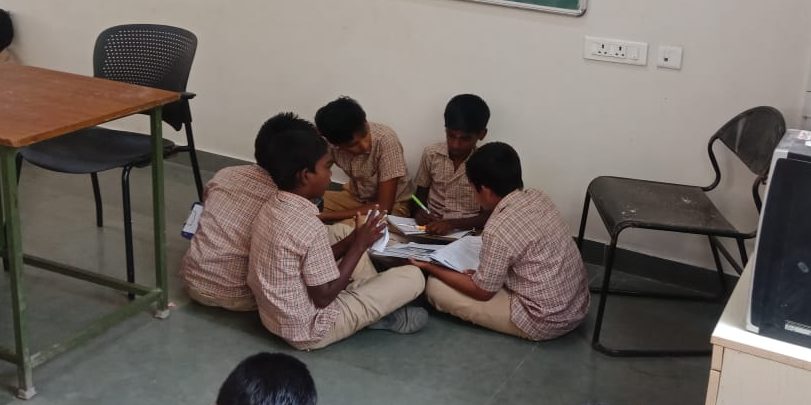
For example, in a focus group discussion with primary school children in Chennai’s Pallavaram, students explained how their teacher uses practices that motivate students to take autonomy in their learning. The students shared that their teacher allows them to share their ideas through presentations and group discussions. Another practice that reflected learners’ autonomy was group learning—where the teacher forms groups of five students, and one of them takes a teacher’s responsibility and encourages others to participate, learn, and explain the concepts.
Similar to the above example, there are multiple ways to make this happen in Indian schools and the following sections of this blog discuss the same.
Enable Learners’ Confidence
In any classroom, there are always possibilities for two types of relationships 1. Learner-Learner relationship and 2. Teacher-Learner relationship. When a teacher takes a step back and plays the role of a facilitator, and observers by constantly providing support to the students to lead classroom proceedings, a Teacher-Learner relationship will be established. A strong Teacher-Learner relationship creates a psychological connection that allows students to feel calm and confident in front of their classmates and educators (Han 2). Once the student is comfortable enough to open up and seek support, this is when a teacher can take the first step towards initiating Learners’ Autonomy.
Let Learners take ownership and drive classrooms
It is challenging to encourage autonomy among the students for reasons such as:
- Mixed-ability students in a classroom
- Diverse wishes of students
- Classrooms with a large number of students.
- Adherence to traditional learning approaches (rote learning, memorization, exam-based learning), etc.
Given these common challenges, as a second step, teachers can initiate a student-level needs assessment in the classroom to understand students’ expectations of the concept, the modes they like to learn, and how they want to be evaluated. For example, one of the questions in needs assessment can be:
How would you like to start the chapter Reflection and Refraction of Light?
- Watch the concept video on the smart board
- Prism and mirror models
- An activity that introduces you to the concept
- Others___
The needs assessment doesn’t have to be a well-designed survey, it can just be 3 questions. The aim is to acknowledge that there are multiple ways to learn a concept and the number of students who want to learn it in different ways.
This exercise will help in two ways:
- Understanding the needs of the students and making possible variations in the teaching mode.
- Students will set the context for learning, leading to increased responsibility, engagement, creativity, and ownership of classroom activities. (Zohrabi 122).
Once the student’s needs are identified through the discussion (needs assessment), the teacher can group or pair up students with similar needs and interests and guide them to create a learning plan. It could be through visual learning, group reading, through models, pictures, etc. Continuing on the previous example, students who want to watch a video first, then look at the model, and read the chapter can be ‘Group 1’. ‘Group 2’ could be students who are interested in seeing the models (mirror and torch reflections) first and watching a video explaining why light passes in a certain direction through different types of glasses.
To make this practice friendly for under-resourced schools, teachers could create a few interesting questions about the topic and give them to the students to discuss; students can verbally present what they think the mechanism of light and object’s properties (and teacher can build from the responses to teach them); each group students can create questions to other students and can have a small quiz competition; the teacher can take students outside the classroom and show real objects related to the concepts, etc. There could be a lot of other ways to let students take ownership of their learning and engage with each other.
Gradually, through these small yet big steps, teachers can influence students to take autonomy in their learning. Studies worldwide and a few practices within Indian classrooms, such as the Pallavaram school mentioned previously, have shown that, when given the opportunity, students are more than passive knowledge absorbers. Ultimately, one of the goals of education is to make them knowledgeable, skilled, and experienced in the concepts that they are learning. To achieve this, Learners’ autonomy has proved to be one of the effective tools.
References (MLA citation style)
- Aggarwal, Richa. “Innovative Approaches and Strategies for Teaching: Dealing with Constraints for Better Learning.” Chitkara University Publications (2015): 217-228.
- Han, Kunni. “Fostering students’ autonomy and engagement in EFL classroom through proximal classroom factors: autonomy-supportive behaviours and student-teacher relationships.” Frontiers in Psychology 12 (2021): 767079.
- Little, David, and Leni Dam. “Learner autonomy: What and why?.” LANGUAGE TEACHER-KYOTO-JALT- 22 (1998): 7-8.
- Stefanou, Candice R., et al. “Supporting autonomy in the classroom: Ways teachers encourage student decision making and ownership.” Educational psychologist 39.2 (2004): 97-110.
- Zohrabi, Mohammad. “Enhancing Learner Autonomy through Reciprocal Approach to Curriculum Development.” English Language Teaching 4.3 (2011): 120-127.
– Siddartha Nemali, Research Lead